The band system

HUB Bands & Upgrade Tests

Five bands, clear goals, and room to grow. Our band system helps students build confidence and become well-rounded athletes through parkour, freerunning, and elements of breakdance.
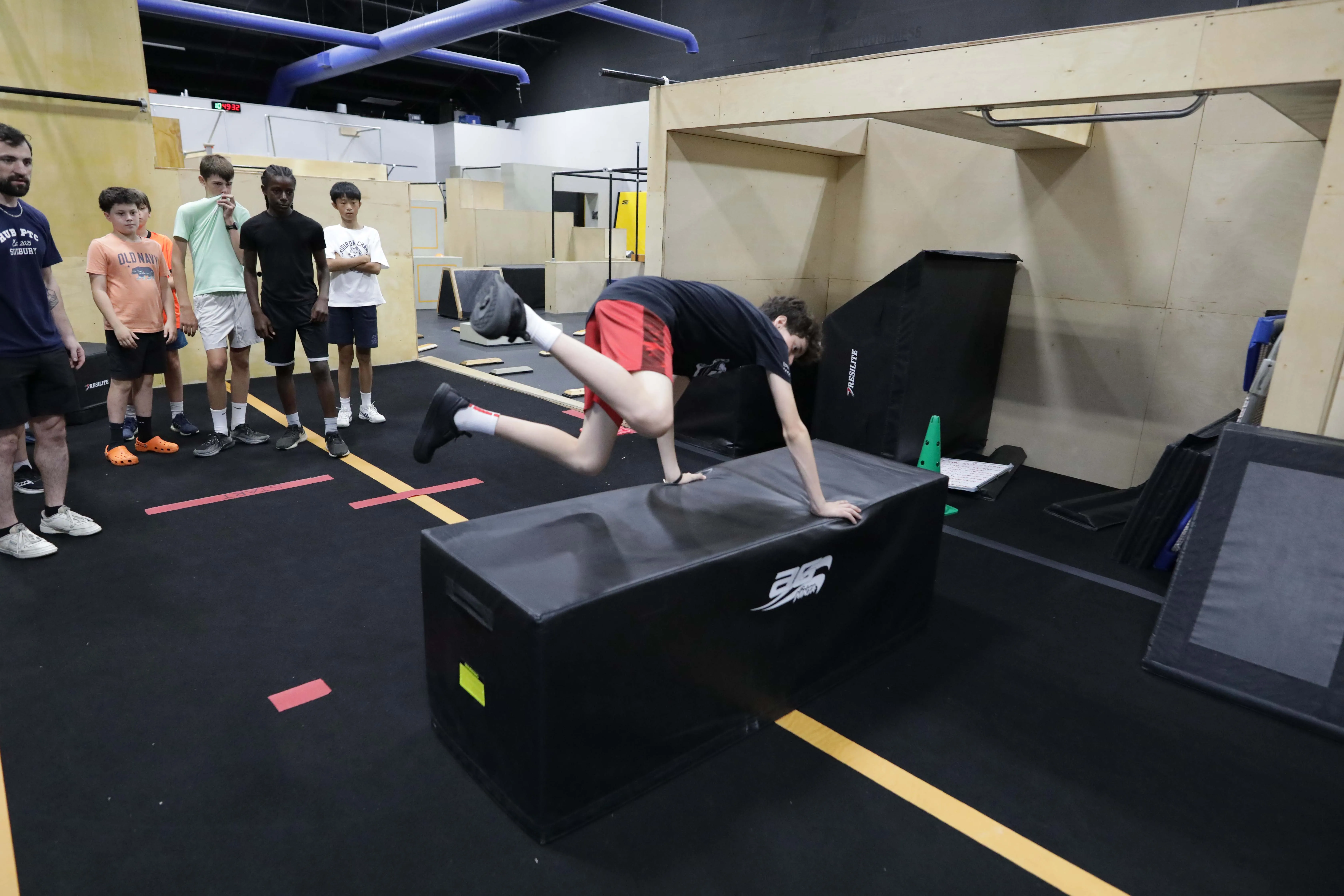
Athlete practicing a vault over a padded block during a HUB class.

The five band levels

Select a band to see all 10 skill challenges, fitness requirements, and parkour culture topics. The order is White, Yellow, Red, Black, then Orange.

LEVEL 1

White

View requirements

Foundations in landing, climbing, balance, vaulting, and movement control.

Complete all 10 skill challenges and every fitness requirement for this band. A challenge with multiple movements or consecutive landings includes all of those parts.

10 skill challenges

  1. Standing precision. Jump 1 body length and stick 3 landings in a row.
  2. Climb up and down. Start and finish in front support, demonstrating control throughout.
  3. Rail balance. Take 6 steps on a rail, holding each step for 3 seconds.
  4. Connected safety vaults. Perform 3 connected safety vaults with smooth transitions and efficient movement. Show proficiency on both sides.
  5. Jump to shoulder roll. Connect a jump to a shoulder roll and stand up quickly, with no head contact on the ground. A small jump from a low box or ledge is allowed.
  6. Underbar. Clear a hip-height obstacle and land with control.
  7. Wall run to cat. Wall run into a cat position and hold for 5 seconds.
  8. Cartwheel and roundoff. Perform both on a line and clearly differentiate the two skills.
  9. Trampoline swan dive. Start on the feet, rotate forward onto the back, then bounce back to the feet.
  10. Palm spin. Perform a palm spin around the corner of a block or wall.

Fitness requirements

  • Core circuit: Under 3:00
  • Push-ups: 10 unbroken; no time limit
  • Precision squats: 20

Core circuit instructions, the precision squat standard, and the climb route will be confirmed before testing.

Parkour knowledge and culture

These topics are being developed for an informal conversation after skills and fitness. The final format and role in band awards will be confirmed before testing.

Who is credited with founding parkour? What 3 disciplines are competed in parkour competitions worldwide?

Additional coached exploration: Kick step precision; surfer precision. These movements are learning material, not extra required challenges unless announced before testing.

LEVEL 2

Yellow

View requirements

More precise landings, connected movements, and confident rail and bar skills.

Complete all 10 skill challenges and every fitness requirement for this band. A challenge with multiple movements or consecutive landings includes all of those parts.

10 skill challenges

  1. Standing rail precision. Jump 1 body length and stick 3 landings in a row.
  2. Climb down to cat hang. From standing on a wall, lower into a cat hang with complete control.
  3. Rail walk and turn. Take 4 steps on a rail, turn around, and walk back. Control each step and contact only the rail until finished.
  4. Jump to side kong and roll. Jump onto a block, side kong to the ground, and connect smoothly into a shoulder roll and standing finish.
  5. Kong precision. Kong to the edge of a trainer and stick 3 times in a row. The test distance will be confirmed before registration opens.
  6. 180 regrab to lache precision. An upstart and 2 swings may build momentum. Perform the 180 by the third forward swing and the precision immediately after the transition.
  7. Cat leap to 180 precision. Use a 1-body-length distance. Show proper 180 technique and begin the 180 as the athlete sinks into the cat position.
  8. Four connected plyos. Connect 4 plyometric jumps with efficient, controlled movement.
  9. Drop precision. From a chest- or head-height wall, stick 3 consecutive landings with control.
  10. Wall spin. Perform on a wall in the gym. Slanted walls are allowed; the conq wall is excluded. Coaches will identify the approved setup.

Fitness requirements

  • Core circuit: Under 2:30
  • Push-ups: 20 unbroken; no time limit
  • Rail squats: 10 consecutive
  • Pull-up: 1

The kong distance, cat-to-180 measurement, drop height, and approved wall-spin setup will be confirmed before testing.

Parkour knowledge and culture

These topics are being developed for an informal conversation after skills and fitness. The final format and role in band awards will be confirmed before testing.

What does SPL stand for? Where is SPL held, including city and gym?

Additional coached exploration: Frontflip or backflip in a puck position, with trampoline allowed; 270 wall run. These movements are learning material, not extra required challenges unless announced before testing.

LEVEL 3

Red

View requirements

Running jumps, climbing combinations, rail control, and the three basic flips.

Complete all 10 skill challenges and every fitness requirement for this band. A challenge with multiple movements or consecutive landings includes all of those parts.

10 skill challenges

  1. Running precision. Stick 3 running precisions consecutively. The 8-step distance measurement will be confirmed before registration opens.
  2. Wall pop and top out. Wall pop, top out, and climb down with control. Final wall height will be confirmed; the draft standard describes a wall at least head height.
  3. Rail walk and squat. Walk to the middle of a high rail, perform a rail squat, turn around, and return. Control the steps, pivots, and squat.
  4. Dive roll. Dive roll over a hip-height obstacle, with a stated distance of 1 body length. Demonstrate control and safe technique.
  5. Kong precision. Kong 1 body length to a box on a level setup, with 3 consecutive controlled sticks.
  6. 180 lache to cat hang. Perform a lache out of a 180 regrab and finish in a cat hang.
  7. Running cat leap and top out. Cover 1.5 body lengths, control the cat leap, and top out quickly and cleanly.
  8. Standing 360 precision. From standing at an edge, jump 1 body length with clean technique and control. Stick 3 times in a row; no running approach.
  9. Three basic flips. Land a backflip, frontflip, and sideflip. Any setup is allowed, including trampoline, ledge, or ground.
  10. Wall flip. Perform a 1-step or 2-step wall flip. Slanted walls are allowed; cheese mats and other matted walls are excluded from the test setup.

Fitness requirements

  • Core circuit: Under 1:30
  • Diamond push-ups: 10
  • Cossack squats: 10 total; 5 per leg
  • Pull-ups: 5
  • Single-leg tibialis raises: 30 total; 15 per leg

Coaches will confirm the running-precision measurement, wall and rail heights, and dive-roll distance before testing.

Parkour knowledge and culture

These topics are being developed for an informal conversation after skills and fitness. The final format and role in band awards will be confirmed before testing.

Name 5 different SPL champions and their disciplines. Which other gyms participate in the NEYPL? Name an athlete from Dodo Freerunning.

Additional coached exploration: Pinch cat; chair spin. These movements are learning material, not extra required challenges unless announced before testing.

LEVEL 4

Black

View requirements

Advanced combinations, twisting skills, rail exits, and a double flip.

Complete all 10 skill challenges and every fitness requirement for this band. A challenge with multiple movements or consecutive landings includes all of those parts.

10 skill challenges

  1. Plyo and stride at height. Perform plyo and stride variations on walls at least hip height, carry momentum, and stick 3 consecutive landings. Right-leg, left-leg, and plyo variations are included. The 1- and 1.5-body-length distance assignments will be confirmed.
  2. Pop vault. Perform a pop vault over a wall taller than the athlete. The final wall-height standard will be confirmed before testing.
  3. Dead hang to rail walk. From a dead hang, climb onto a rail and walk to its end with control.
  4. Dive roll precision. Starting on a hip-height wall, perform a safe dive roll across a block.
  5. Double kong and dive kong clear. Perform a double kong on 2 level walls separated by 1 body length, and a dive kong clear. The dive kong clear setup will be confirmed.
  6. Flyaway. Demonstrate strong technique and a controlled landing.
  7. Running cat to 180 precision. Connect a running cat to a 180 precision and stick the 180 landing 3 times in a row, with no long pause between cat and 180. The 1.5-body-length measurement will be confirmed.
  8. A-twist and back full. Perform both on the ground or from a block no higher than hip height.
  9. Rail precision and exit. Stick a rail precision at height. After coach approval of the stick, perform a controlled soul circle or toe shoot exit.
  10. Double flip. Perform any double flip and land on the feet with control. Trampoline, air track, and mat setups are allowed.

Fitness requirements

  • Core circuit: Under 1:00
  • Handstand hold: 5 seconds
  • Pistol squat: 1 per leg
  • Pull-ups: 10
  • Single-leg tibialis raises: 60 total; 30 per leg
  • Nordic curls: 5; assistance allowed

Coaches will confirm distance assignments, rail heights, dive-roll and dive-kong setups, and handstand support rules before testing.

Parkour knowledge and culture

These topics are being developed for an informal conversation after skills and fitness. The final format and role in band awards will be confirmed before testing.

Which country contains the Man Power gap? Who first landed a standing double back? Name 3 locations that hosted Red Bull Art of Motion.

Additional coached exploration: Eagle drop; window sill precision. These movements are learning material, not extra required challenges unless announced before testing.

LEVEL 5

Orange

View requirements

The final band: advanced precisions, timed climbing, double twists, and twisting doubles.

Complete all 10 skill challenges and every fitness requirement for this band. A challenge with multiple movements or consecutive landings includes all of those parts.

10 skill challenges

  1. Running precision. Jump 2 body lengths and stick 3 consecutive landings with control.
  2. Timed climb-ups. Perform 5 climb-ups from a cat hang in under 15 seconds.
  3. Rail precision at height. Demonstrate a controlled rail precision at height.
  4. One and three. Perform a one and three with a controlled roll. A kicker and thin mat are allowed. Coaches will demonstrate the exact movement before testing.
  5. Level rail kong precision. Perform a rail kong precision over 1.5 body lengths to a level wall or rail.
  6. Kip cast lache. Perform a clean kip immediately followed by a lache precision to a level wall.
  7. Pole cat to 180 precision. Show control in a pole cat and 180 precision. The 1.5-body-length distance measurement will be confirmed.
  8. Double A-twist and double full. Perform both on the ground or from a kicker or hip-height ledge. Any setup is allowed, including scoot, roundoff, or TDR.
  9. Twisting double flip. Perform any double flip containing a twist with control, such as a fliffus, half in, full in, or full out. Trampoline, air track, and mat setups are allowed.
  10. Cast away. Land a cast away with control. Any setup is allowed, including swing, hang, pop, or front support.

Fitness requirements

  • V-ups: 50 in under 1:00
  • Handstand push-ups: 5
  • Pistol squats: 10 total; 5 per leg
  • Muscle-ups: 5
  • Kip-up: On the ground
  • Dead hang: 2:00
  • Box jump: Chest height

Coaches will confirm rail heights, climb-up resets, the one and three, handstand support, and muscle-up standards before testing.

Parkour knowledge and culture

These topics are being developed for an informal conversation after skills and fitness. The final format and role in band awards will be confirmed before testing.

Name 5 athletes in a CapStone video. What is the most-viewed parkour video on YouTube? Who coined the term freerun?

Additional coached exploration: Reverse lache; dive reverse vault. These movements are learning material, not extra required challenges unless announced before testing.

Use these requirements as training goals with your coach. A few setup measurements and exercise instructions are still being finalized and are noted within each band. Final testing details will be confirmed before registration opens.

Upgrade nights

Goals that keep you growing

Bands help us group classes, but their bigger purpose is to give students clear goals and encourage well-rounded training. You will see parkour, freerunning, and elements of breakdance in the progression so athletes explore different disciplines and develop a wider range of movement skills.

You might complete some challenges at one Upgrade Night and discover others you need to practice. That is part of the process. Each session helps you recognize progress, find your next goals, and keep growing across the disciplines we teach. To earn the next band, complete all of its skill challenges and fitness requirements.

Starting January 2027

Upgrade Night schedule

Starting in January 2027, HUB will host Upgrade Nights every quarter. Upcoming sessions, locations, and registration will appear here as each event opens for booking.

Quarterly Upgrade Nights begin January 2027. Session dates and registration are coming soon.

Common questions

Do I lose my band?

No — a band you earn is yours.

How long does each band take?

Every athlete progresses at their own pace. Advancement depends on completing the skill and fitness requirements, not on a set number of classes. Upgrade Nights take place every quarter, starting in January 2027.

What if my kid is between bands?

Coaches place every athlete in the group that fits, and they train toward the next band from there.

How do athletes earn a new band?

Complete all 10 skill challenges for your target band with coach approval, including each required movement and consecutive landing, then complete every fitness requirement for that level. The knowledge and culture component is being developed as an informal final conversation.

Do adults use the band system?

Bands are for our youth and teen classes. Adults train in all-levels sessions and progress at their own pace — no formal testing.

Is my kid stuck if they don't upgrade right away?

You may complete some challenges at an Upgrade Night and still have others to work on. That is useful progress: you learn what is going well and leave with clear goals for training. Earning the next band requires all of its skill challenges and fitness requirements.

Will there be a knowledge test?

We are developing a short, informal parkour knowledge and culture component to follow the skill challenges and fitness test. The final format will be shared before testing begins.

How can we prepare?

Open your target band above and review the requirements with your coach. Work on skills across the different disciplines, build consistency, and use the challenges to guide your practice. Coaches will explain any remaining setup details before testing begins.